Apple iPhone Pricing Strategy
A pricing strategy project that examines how Apple sustains premium iPhone pricingin a mature and highly competitive smartphone market. The analysis combines original survey evidencewith financial-statement validationto understand how brand, versioning, and ecosystem economics reinforce Apple's pricing power.
Project Overview
This project explores a central pricing question for Apple: how to maintain premium iPhone pricing without weakening margins or long-term customer value in a market where hardware features are increasingly similar across brands. The core issue was whether Apple should raise prices, maintain its current premium logic, or use broader discounts to defend share.
Research Goal
The goal was to evaluate whether Apple's premium pricing is still economically sustainable. Using survey data and secondary financial evidence, the project tested whether Apple's pricing power comes from brand equity, structured product versioning, and ecosystem lock-in rather than from short-term discounting.
Survey Design and Results
The survey measured willingness to pay, upgrade thresholds, switching behavior, and ecosystem attachment. A total of 37 valid responseswere analyzed, with the sample largely skewed toward iPhone users, making the findings especially useful for understanding the installed Apple user base.
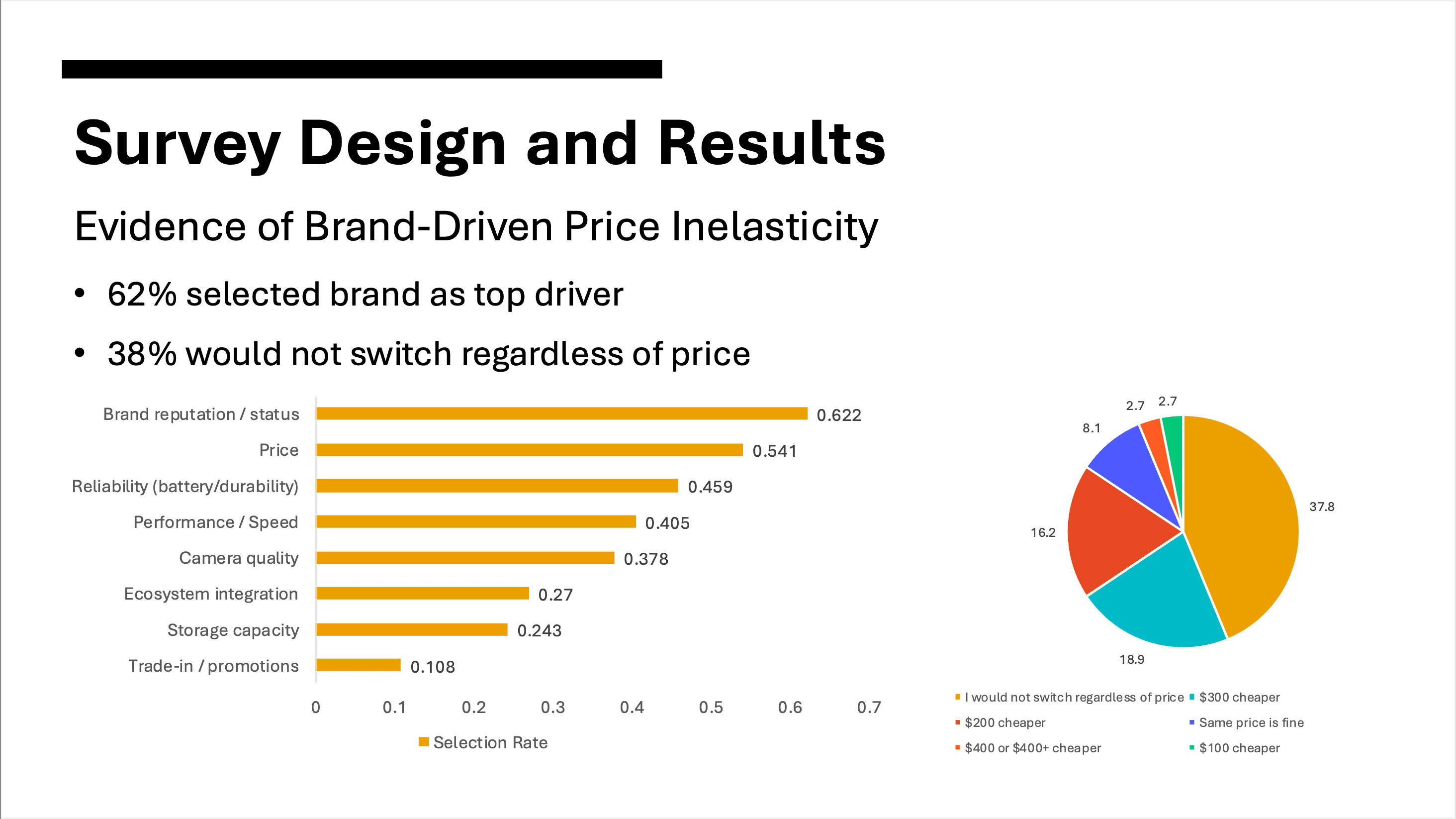
The first result image highlights two major findings. On the left, brand reputation and statuswas selected more often than price as a key purchase driver, with a selection rate of about 0.622 versus 0.541 for price. On the right, 37.8% of respondents said they would not switch regardless of price, suggesting meaningful brand-driven switching resistance.
Upgrade Thresholds and Pricing Architecture
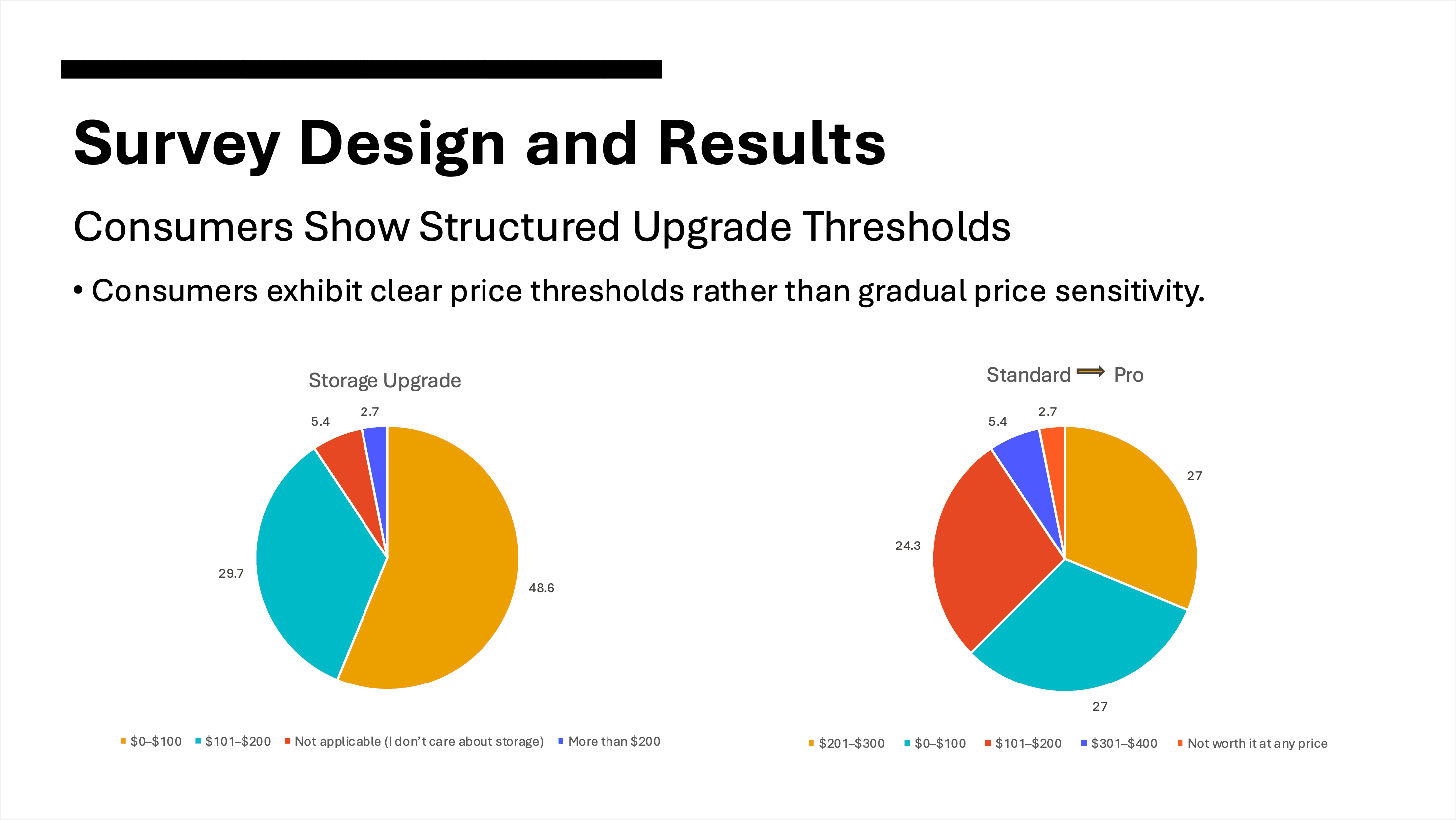
The second result image shows that consumers do not respond to upgrades in a smooth, linear way. Instead, they cluster around clear price thresholds, which makes Apple's versioning strategy especially effective.
For storage upgrades, most respondents accepted a $0-$200price gap; for a Standard to Proupgrade, most responses clustered below $300. These step-like thresholds imply that Apple's lineup works as a pricing architecture, not just a product lineup.
Financial Validation and Insights
The survey findings were reinforced with Apple's broader financial structure. According to the report, Apple's 2025 total net sales were $416.161B, iPhone revenue was $209.586B, and Services revenue reached $109.158B. Total gross margin was 46.9%, while Services gross margin reached 75.4%, showing why hardware pricing should be evaluated through a lifetime-value lens rather than device margin alone.
Taken together, the evidence suggests that Apple's pricing power is sustained by three reinforcing mechanisms: premium signaling, ecosystem lock-in, and nonlinear versioning. This combination allows Apple to maintain high reference prices while using storage tiers, Pro models, and high-margin Services to grow profitability without falling into price-war dynamics.
Managerial Implications
The strongest implication is that Apple should continue a disciplined premium-pricing strategyrather than broad-based discounting. The report recommends maintaining flagship pricing while strengthening segmentation, expanding Services bundling, and avoiding promotions that could lower consumers' internal reference prices over time.
More broadly, this case shows that firms cannot simply decide to charge premium prices unless pricing power is structurally supported by differentiation, switching costs, and complementary value creation. In Apple's case, pricing works because the product, ecosystem, and revenue model reinforce one another as a coherent system.